How To Install VMware Player On Ubuntu 11.04/Linux Mint 11
Version 1.0
Author: Falko Timme
Follow me on Twitter
This tutorial provides step-by-step instructions on how to install VMware Player on an Ubuntu 11.04 or Linux Mint 11 desktop system. With VMware Player you can create and run guest operating systems ("virtual machines") such as Linux, Windows, FreeBSD, etc. on your desktop, i.e., you can run multiple operating systems on the same hardware which saves a lot of money.
Also, with VMware Player you can let your old Windows desktop (that you previously converted into a VMware virtual machine with VMware Converter, as described in this tutorial: http://www.howtoforge.com/vmware_converter_windows_linux) run under your Ubuntu/Linux Mint desktop. This can be useful if you depend on some applications that exist for Windows only, or if you want to switch to Linux slowly.
I do not issue any guarantee that this will work for you!
1 Preliminary Note
I'm using the user name falko with the home directory /home/falko here - please adjust this appropriately.
2 VMware Player
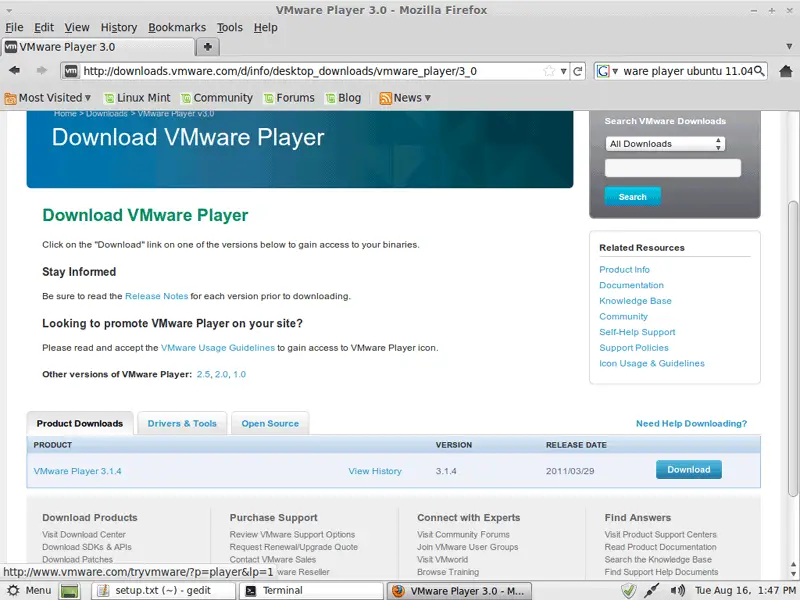
To download VMware Player, go to http://www.vmware.com/go/downloadplayer/ and click on Download:
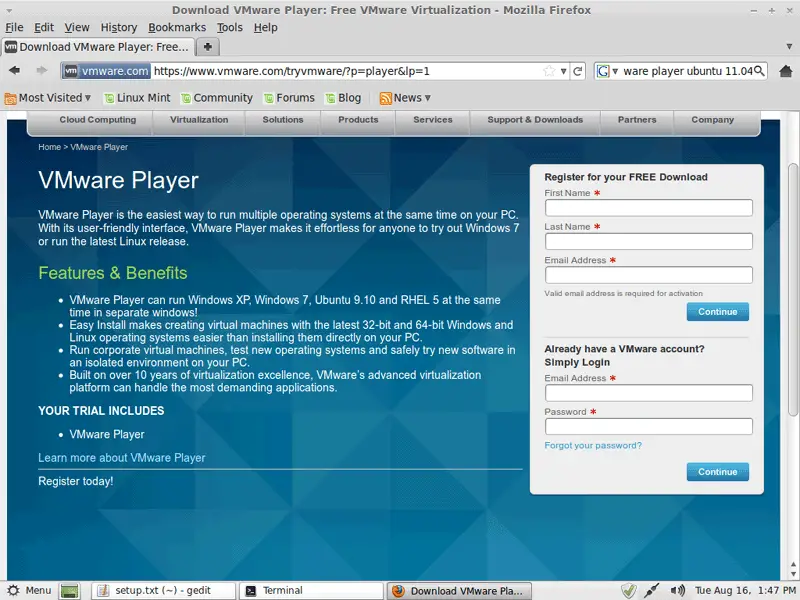
On the next page, log in with your existing VMware account or create a new one:
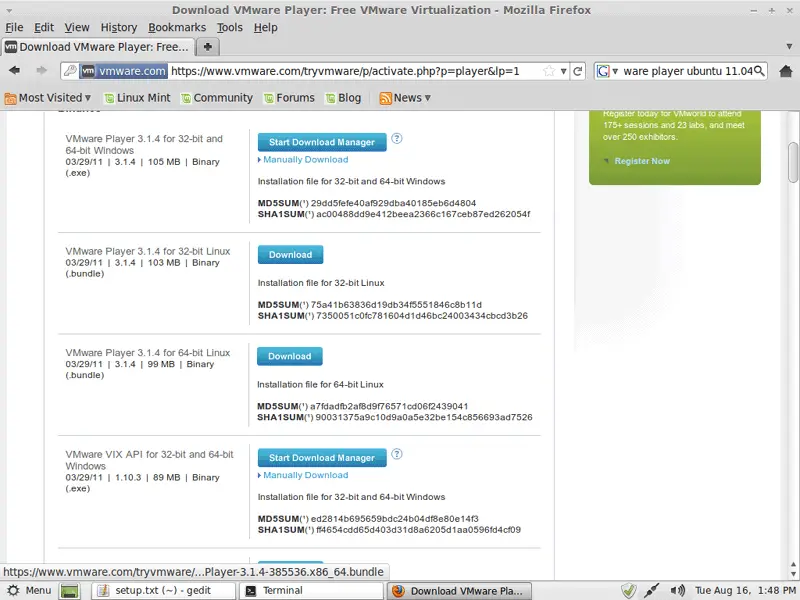
Follow the on-screen instructions. At the end, you should receive an email with a link to your download page. On the download page, select the right VMware Player for your architecture (32-bit or 64-bit) and click on the Download button:
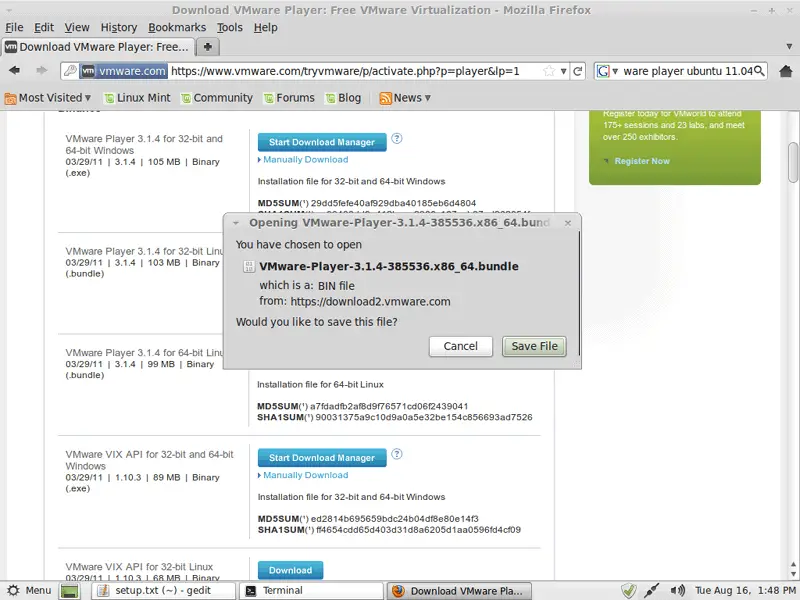
Select Save File in the Firefox download dialogue:
Then open a terminal and run the following command to install some packages needed by the VMware Player installer:
sudo apt-get install build-essential linux-headers-`uname -r`
Then go to the location where you saved the VMware Player file, e.g. /home/falko/Downloads (replace falko with your own username!):
cd /home/falko/Downloads
Take a look at the contents of the directory:
ls -l
[email protected] ~/Downloads $ ls -l
total 101136
-rw-r--r-- 1 falko falko 103561067 2011-08-16 13:49 VMware-Player-3.1.4-385536.x86_64.bundle
[email protected] ~/Downloads $
We can start the VMware Player installation as follows:
gksudo bash ./VMware-Player-3.1.4-385536.x86_64.bundle
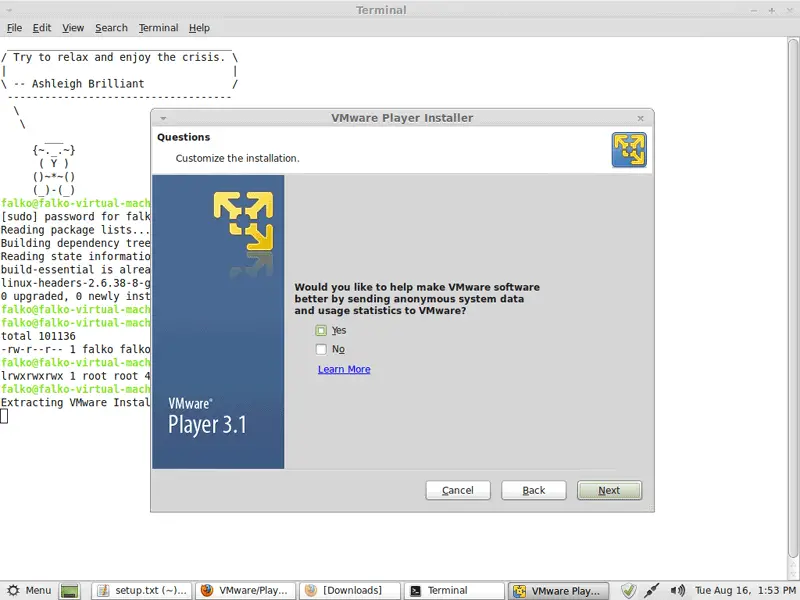
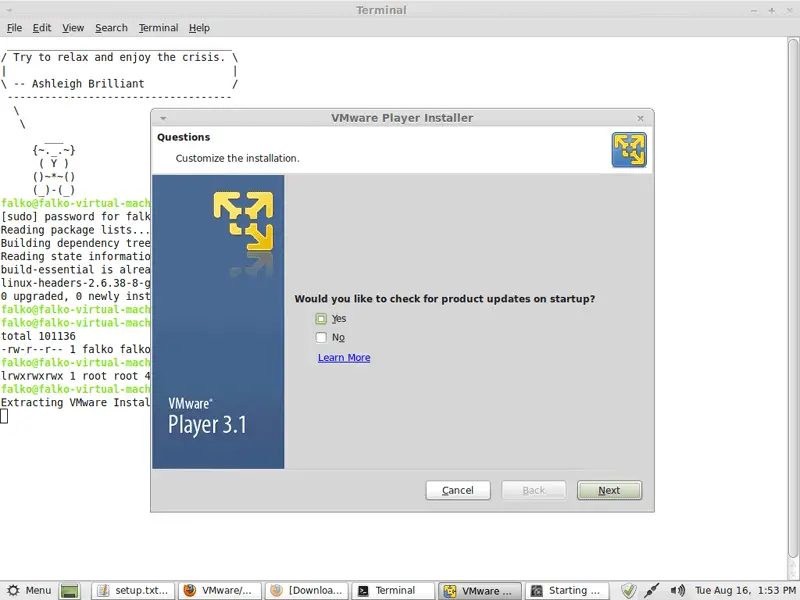
This will start the graphical VMware Player installation wizard. Just click your way through it:
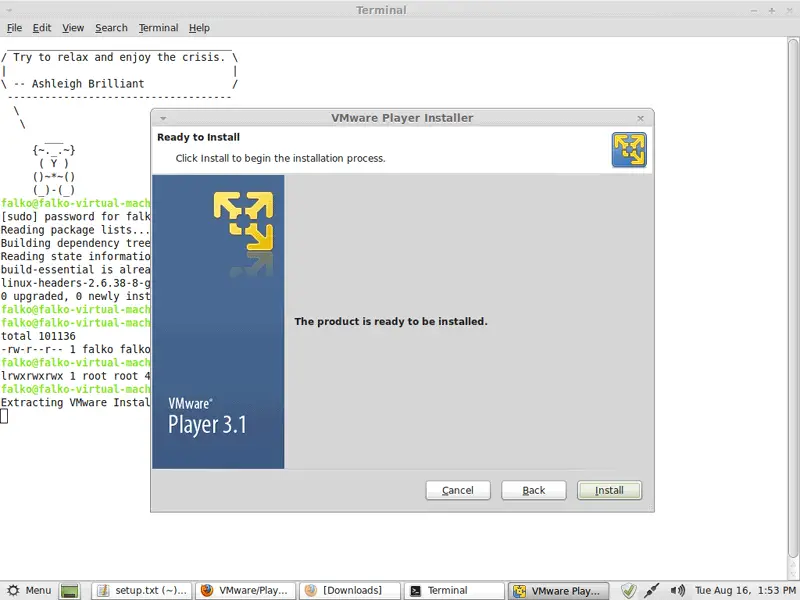
Click on Install to start the installation:
Sub pages
Suggested articles
23 Comment(s)
Comments
The demonstration was really helpful.
thank you. :)
Thanks for sharing the step by step by guide since I am new to Ubuntu and want to run my VM inside it.
BTW, how did you get the windows like start menu in Ubuntu?
Grazie la guida è stata molto chiara ed esaustiva - Thank very good explain
That is a MINT feature - check out #13 Maya release - yenna daa?
thanks man, I was short of the install build-essential linux-headers part and getting an installation error.
Better instructions will be very very difficult to find (not that I am lookin for them any longer :-)
Thank you!
Following these instructions, VMware Player installed on Ubuntu 12.04. Thanks
Is there some other command that I should use in terminal?
Please help
Thank you
Downloading with Google's chrome browser results in a file with .txt as a suffix, instead of .bundle. The installation subsequently failed. I couldn't be bothered to find out why. Switching to firefox and downloading it again gave the proper file suffix .bundle and installation succeeded.
Just rename the .txt file to a .bundle file, and it works great.
This (with one minor change) worked in Linux Mint 14 KDE
The minor change was, of course to use
kdesudo
instead of
gksudo
Thanks very much for the how-to!!
TI
Falko, thanks a lot for this simple but comprehensive guideline. Wanted to ensure people find it for this versions as well.
thank you man you are a life saver
thanks man, it worked for me on linux mint 13. great
Thanx 4 Ur Help, Falko!...a Gentleman & a Scholar!
Thanks for the nice guide!
gksudo treats '-' as leading parameter values, so command line as represented above becomes invalid! error message: GConf-CRITICAL **: gconf_value_free: assertion 'value != NULL' failed simple solution - rename file before running command! e.g mv VMware-Player-3.1.4-385536.x86_64.bundle vmware.bundle
very helpful i installed workstation, and it works g8, that bro.
Thanks very much. This worked with Mint 17.1 and VMware Player 12.
Thanks Bro. Works fine
Appreciation for this excellent installation guide. I managed to be successful with it right from the start. Thank you.
I tried ti install Virtual box several time but fail to do. Please help me. i am using Kali 2.0 in 32bit machine. i have to face following error when try to install virtualmachine
[email protected] // :~# apt-get install virtualboxReading package lists... DoneBuilding dependency tree Reading state information... DoneYou might want to run 'apt-get -f install' to correct these:The following packages have unmet dependencies: opera : Depends: libgstreamer-plugins-base0.10-0 (>= 0.10.16) but it is not installable Depends: libgstreamer0.10-0 (>= 0.10.15) but it is not installable Depends: gstreamer0.10-plugins-good but it is not installable virtualbox : Depends: virtualbox-dkms (>= 5.0.16-dfsg-2) but it is not going to be installed or virtualbox-source (>= 5.0.16-dfsg-2) but it is not going to be installed or virtualbox-modules Depends: libgsoap8 but it is not going to be installed Depends: libvncserver1 (>= 0.9.10) but it is not going to be installed Conflicts: virtualbox-5.0 but 5.0.16-105871~Ubuntu~wily is to be installed Recommends: virtualbox-qt (= 5.0.16-dfsg-2) but it is not going to be installed virtualbox-5.0 : Depends: libssl1.0.0 (>= 1.0.0) but it is not installable Depends: libvpx2 (>= 1.4.0) but it is not installable Conflicts: virtualbox Recommends: libsdl-ttf2.0-0 but it is not going to be installed Recommends: linux-headers but it is not installableE: Unmet dependencies. Try 'apt-get -f install' with no packages (or specify a solution).[email protected] // :~#
guys,
its not req these much procedures to install VM.
just download VM..
open terminal --> type 'sudo -i' --> type password --> drag and Drop the application ---> install -->> done
try it..!!
thanks
English |
Deutsch