The Perfect Setup - Debian Sarge (3.1) - Page 5
Apache
Run
apt-get install apache2
apache2-doc
apt-get install libapache2-mod-php4 libapache2-mod-perl2 php4 php4-cli php4-common
php4-curl php4-dev php4-domxml php4-gd php4-imap php4-ldap php4-mcal php4-mhash
php4-mysql php4-odbc php4-pear php4-xslt curl libwww-perl imagemagick
(1 line!)
Edit /etc/apache2/apache2.conf. Change
DirectoryIndex index.html index.cgi index.pl index.php index.xhtml |
to
DirectoryIndex index.html index.htm index.shtml index.cgi index.php index.php3 index.pl index.xhtml |
Edit /etc/mime.types and comment out the following lines:
#application/x-httpd-php phtml pht php |
Edit /etc/apache2/mods-enabled/php4.conf and comment out the following lines:
<IfModule mod_php4.c> |
Edit /etc/apache2/ports.conf and add Listen 443:
Listen 80 |
Now we have to enable some Apache modules (SSL, rewrite and suexec):
a2enmod ssl
a2enmod rewrite
a2enmod suexec
a2enmod include
Restart Apache:
/etc/init.d/apache2 restart
Proftpd
apt-get install proftpd
<- standalone
For security reasons you can add the following lines to /etc/proftpd.conf (thanks to Reinaldo Carvalho; more information can be found here: http://proftpd.linux.co.uk/localsite/Userguide/linked/userguide.html):
DefaultRoot ~
IdentLookups off
ServerIdent on "FTP Server ready."
and restart Proftpd:
/etc/init.d/proftpd restart
Webalizer
apt-get
install webalizer
<- /var/www/webalizer
<- Usage Statistics for
<- /var/log/apache/access.log.1
Synchronize
the System Clock
It is a good idea to synchronize the system clock with an NTP (network time protocol) server over the internet. Simply run
apt-get install ntp ntpdate
and your system time will always be in sync.
Install some
Perl Modules needed by SpamAssassin (comes with ISPConfig)
Installation using the Perl Shell
Login to your command line as root and run the following command to start the Perl shell:
perl -MCPAN -e shell
If you run the Perl shell for the first time you will be asked some questions. In most cases the default answers are ok.
Please note: If you run a firewall on your system you might have to turn it off while working on the Perl shell in order for the Perl shell to be able to fetch the needed modules without a big delay. You can switch it on afterwards.
The big advantage of the Perl shell compared to the two other methods described here is that it cares about dependencies when installing new modules. I.e., if it turns out that a prerequisite Perl module is missing when you install another module the Perl shell asks you if it should install the prerequisite module for you. You should answer that question with "Yes".
Run the following commands to install the modules needed by SpamAssassin:
install HTML::Parser
install DB_File
install Net::DNS
(when prompted to enable tests, choose no)
q (to leave the Perl shell)
If a module is already installed on your system you will get a message similar to this one:
HTML::Parser is up to date.
Successful installation of a module looks like this:
/usr/bin/make install -- OK
Compile a Custom
Kernel
If you need to
compile a new kernel for some reason (e.g. because you want to use the latest
bleeding-edge kernel or need a feature that the standard Debian kernel does
not offer), you can find more information here: Debian-Kernel-Compile-Howto.
The End
The configuration
of the server is now finished, and if you wish you can now install ISPConfig
on it.
A Note On SuExec
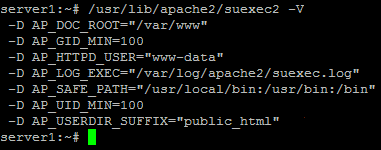
If you want to run CGI scripts under suExec, you should specify /var/www as the home directory for websites created by ISPConfig as Debian's suExec is compiled with /var/www as Doc_Root. Run /usr/lib/apache2/suexec2 -V, and the output should look like this:
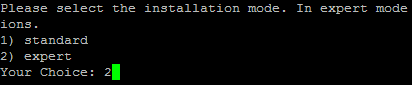
To select /var/www as the home directory for websites during the installation of ISPConfig do the following: When you are asked for the installation mode, select the expert mode.
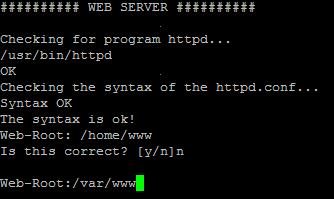
Later during the installation you are asked if the default directory /home/www should be the directory where ISPConfig will create websites in. Answer n and enter /var/www as the home directory for websites.
Links