
This tutorial exists for these OS versions
- openSUSE 12.2
- openSUSE 12.1
- openSUSE 11.4
- openSUSE 11.3
On this page
Installing Nginx With PHP5 (And PHP-FPM) And MySQL Support On OpenSUSE 11.4
Version 1.0
Author: Falko Timme  Follow me on Twitter
Nginx (pronounced "engine x") is a free, open-source, high-performance HTTP server. Nginx is known for its stability, rich feature set, simple configuration, and low resource consumption. This tutorial shows how you can install Nginx on an OpenSUSE 11.4 server with PHP5 support (through PHP-FPM) and MySQL support.
I do not issue any guarantee that this will work for you!
1 Preliminary Note
In this tutorial I use the hostname server1.example.com with the IP address 192.168.0.100. These settings might differ for you, so you have to replace them where appropriate.
2 Installing MySQL 5
First we install MySQL 5 like this:
yast2 -i mysql mysql-client mysql-community-server
Then we create the system startup links for MySQL (so that MySQL starts automatically whenever the system boots) and start the MySQL server:
chkconfig -f --add mysql
/etc/init.d/mysql start
Now check that networking is enabled. Run
netstat -tap | grep mysql
It should show something like this:
server1:~ # netstat -tap | grep mysql
tcp        0      0 *:mysql                 *:*                     LISTEN      2360/mysqld
server1:~ #
If it does not, edit /etc/my.cnf and comment out the option skip-networking:
vi /etc/my.cnf
[...] #skip-networking [...] |
and restart your MySQL server:
/etc/init.d/mysql restart
(If you get the message You do not have a valid vim binary package installed. Please install either "vim", "vim-enhanced" or "gvim"., please run
yast2 -i vim
to install vi and try again. )
Run
mysql_secure_installation
to set a password for the user root (otherwise anybody can access your MySQL database!):
server1:~ # mysql_secure_installation
NOTE: RUNNING ALL PARTS OF THIS SCRIPT IS RECOMMENDED FOR ALL MySQL
SERVERS IN PRODUCTION USE! PLEASE READ EACH STEP CAREFULLY!
In order to log into MySQL to secure it, we'll need the current
password for the root user. If you've just installed MySQL, and
you haven't set the root password yet, the password will be blank,
so you should just press enter here.
Enter current password for root (enter for none): <-- ENTER
OK, successfully used password, moving on...
Setting the root password ensures that nobody can log into the MySQL
root user without the proper authorisation.
Set root password? [Y/n] <-- Y
New password: <-- fill in your desired MySQL root password
Re-enter new password: <-- confirm that password
Password updated successfully!
Reloading privilege tables..
... Success!
By default, a MySQL installation has an anonymous user, allowing anyone
to log into MySQL without having to have a user account created for
them. This is intended only for testing, and to make the installation
go a bit smoother. You should remove them before moving into a
production environment.
Remove anonymous users? [Y/n] <-- Y
... Success!
Normally, root should only be allowed to connect from 'localhost'. This
ensures that someone cannot guess at the root password from the network.
Disallow root login remotely? [Y/n] <-- Y
... Success!
By default, MySQL comes with a database named 'test' that anyone can
access. This is also intended only for testing, and should be removed
before moving into a production environment.
Remove test database and access to it? [Y/n] <-- Y
- Dropping test database...
... Success!
- Removing privileges on test database...
... Success!
Reloading the privilege tables will ensure that all changes made so far
will take effect immediately.
Reload privilege tables now? [Y/n] <-- Y
... Success!
Cleaning up...
All done! If you've completed all of the above steps, your MySQL
installation should now be secure.
Thanks for using MySQL!
server1:~ #
3 Installing Nginx
Nginx is available as a package for OpenSUSE 11.4 which we can install as follows:
yast2 -i nginx-0.8
Then we create the system startup links for nginx and start it:
chkconfig -f --add nginx
/etc/init.d/nginx start
Type in your web server's IP address or hostname into a browser (e.g. http://192.168.0.100), and you should see the following page:
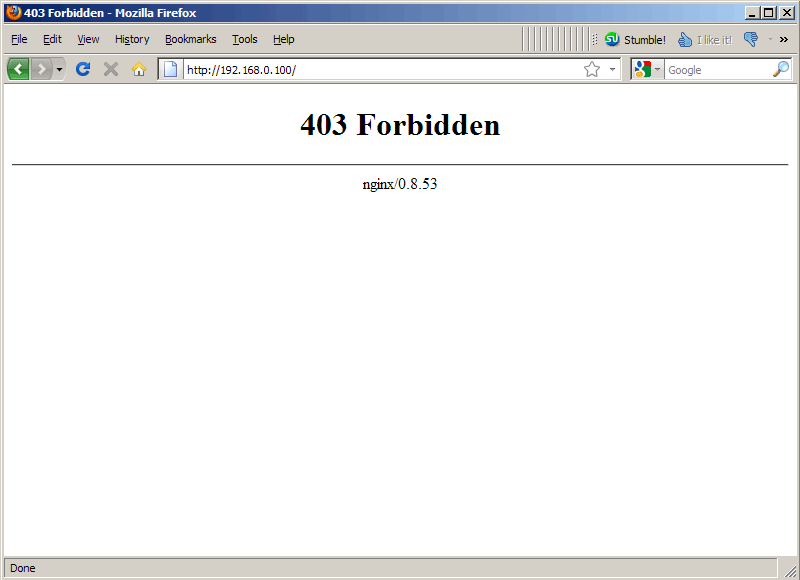
You get a 403 forbidden error because on OpenSUSE 11.4, the default nginx document root is /srv/www/htdocs, and there's no index page in /srv/www/htdocs.
4 Installing PHP5
We can make PHP5 work in nginx through PHP-FPM (PHP-FPM (FastCGI Process Manager) is an alternative PHP FastCGI implementation with some additional features useful for sites of any size, especially busier sites) which we install as follows:
yast2 -i php5-fpm
Before we start PHP-FPM, rename /etc/php5/fpm/php-fpm.conf.default to /etc/php5/fpm/php-fpm.conf:
mv /etc/php5/fpm/php-fpm.conf.default /etc/php5/fpm/php-fpm.conf
Then open /etc/php5/fpm/php-fpm.conf...
vi /etc/php5/fpm/php-fpm.conf
... and change error_log to /var/log/php-fpm.log and uncomment pm.min_spare_servers and pm.max_spare_servers:
[...] error_log = /var/log/php-fpm.log [...] pm.min_spare_servers = 5 [...] pm.max_spare_servers = 35 [...] |
Next create the system startup links for php-fpm and start it:
chkconfig -f --add php-fpm
/etc/init.d/php-fpm start
PHP-FPM is a daemon process (with the init script /etc/init.d/php-fpm) that runs a FastCGI server on port 9000, as you can see in the output of
netstat -tapn
server1:~ # netstat -tapn
Active Internet connections (servers and established)
Proto Recv-Q Send-Q Local Address           Foreign Address         State       PID/Program name
tcp        0      0 127.0.0.1:9000          0.0.0.0:*               LISTEN      4229/php-fpm.conf)
tcp        0      0 0.0.0.0:3306            0.0.0.0:*               LISTEN      2360/mysqld
tcp        0      0 0.0.0.0:111             0.0.0.0:*               LISTEN      1378/rpcbind
tcp        0      0 0.0.0.0:80              0.0.0.0:*               LISTEN      3795/nginx
tcp        0      0 0.0.0.0:22              0.0.0.0:*               LISTEN      1190/sshd
tcp        0      0 127.0.0.1:25            0.0.0.0:*               LISTEN      1425/master
tcp        0      0 :::111                  :::*                    LISTEN      1378/rpcbind
tcp        0      0 :::22                   :::*                    LISTEN      1190/sshd
tcp        0      0 ::1:25                  :::*                    LISTEN      1425/master
server1:~ #